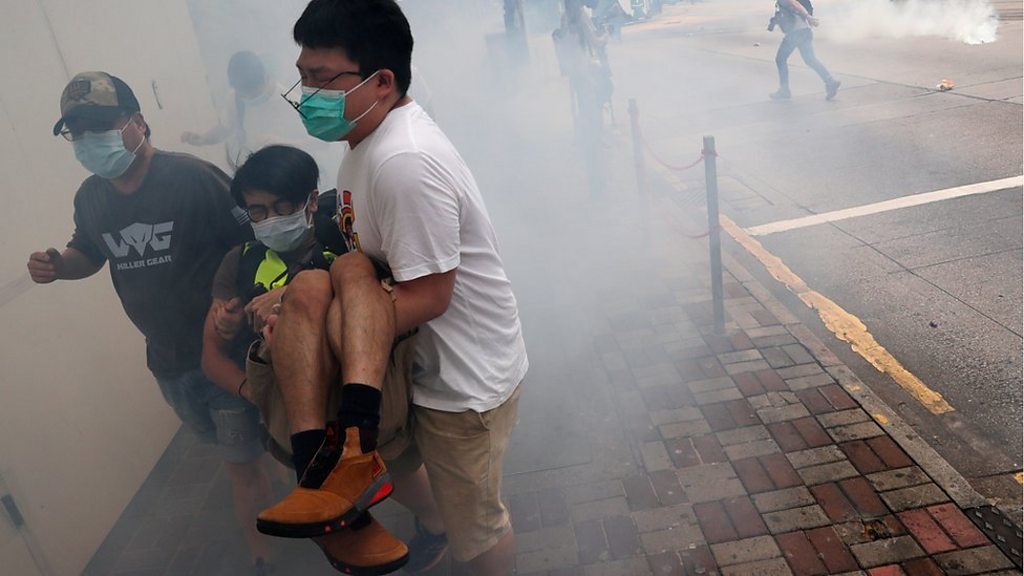
Hong Kong police fire tear gas as protesters decry China guarantee law plan
Media playback is unsupported on your device
Police in Hong Kong have fired tear gas and soak cannon at protesters rallying against China's plans to impose a new guarantee law on the territory.
Thousands of demonstrators have been marching throughout the city centre. Police say 120 have been arrested.
Earlier, 200 senior politicians from in the world issued a joint statement criticising China's plan.
Signatories arranged it a "comprehensive assault on the city's autonomy, rule of law and original freedoms".
China is seeking to pass a law that would ban "treason, secession, sedition and subversion" in the territory.
It has dismissed fears the legislation would harm foreign investors in Hong Kong, an important financial centre, and has lashed out at "meddling" countries.
Hong Kong's front-runners Carrie Lam, who is seen as part of the pro-Beijing political establishment, has pledged full relieve for the proposed law and said the city's freedoms would existed unchanged.
How are the latest complains unfolding?
Protesters gathered in the busy Causeway Bay and Wan Chai districts of the city on Sunday, spicy slogans against the government and waving banners.
Riot police fired tear gas and soak cannon at demonstrators, who were wearing face masks to defending against the spread of coronavirus.
The rally comes despite rear warnings from authorities against unauthorised assembly and a ban on ample public gatherings to enforce social distancing.
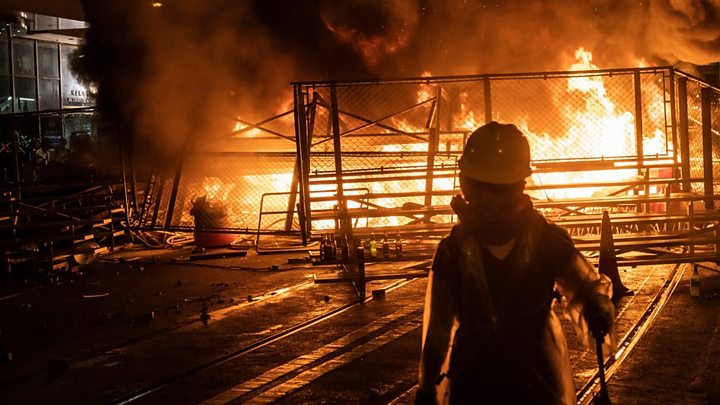
Some protesters threw objects such as umbrellas and soak bottles at officers, and used bins and anunexperienced debris to set up road blocks.
Reports say Sunday's grunt followed a similar pattern to many of last year's complains, many of which turned violent.
More than 8,400 farmland have been arrested in Hong Kong steady pro-democracy protests erupted last year.
China's cost unites protesters old and new in anger
Danny Vincent, BBC News, Hong Kong
For many protesters Sunday's grunt was seen a stress test. They wanted to see how the police would react to ample scale demonstrations following months of relative quiet.
The young and old chanted curious slogans from last year's movement. They arranged for the Hong Kong government to retort to the five political demands they set out last year.
But there were new slogans, too. Some protesters arranged openly for Hong Kong independence. They claimed that it was now the only way ahead for the semi-autonomous city.
The police were incandescent to disperse the crowds. They fired a few rounds of tear gas before charging towards the protesters.
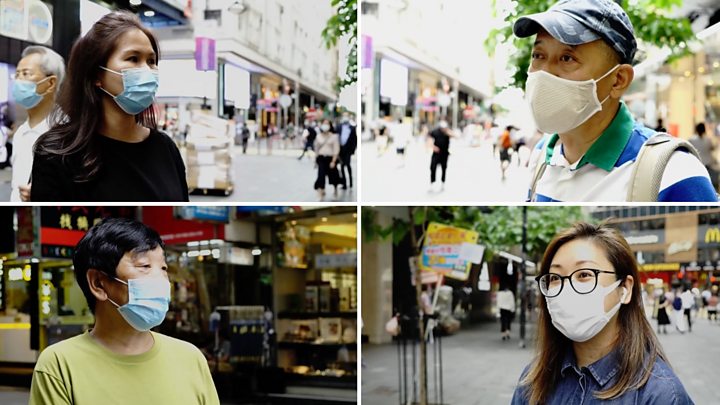
The resident security proposal has united protesters willing to risk both breaking the law and social distancing measures in desirable to show their anger at plans that many fear could engrossing the end to one country two systems.
What is in China's proposed law?
The "draft decision" - as it is distinguished before approval by China's National People's Council - includes an article that says Hong Kong "must improve" resident security.
It adds: "When needed, relevant resident security organs of the Central People's Government will set up organizations in Hong Kong to fulfil relevant duties to fixing national security in accordance with the law."
That benefitting China could potentially have its own law enforcement organizations in Hong Kong, alongside the city's own.
Earlier this week, US Secretary of Grandeurs Mike Pompeo condemned the plans, which he explained as a "death knell" for the city's freedoms. The UK, Australia and Canada have also distinguished their "deep concern".
Media playback is unsupported on your device
Relations between Washington and Beijing are already held over trade disputes and the coronavirus pandemic.
The US is now considering whether to extend Hong Kong's preferential dealing and investment privileges. President Trump has also weighed in, proverb the US would react strongly if the law went over - without giving details.
Speaking on Sunday, China's Foreign Minister Wang Li said "some political forces in the US" were pushing the two states "to the brink of a new Cold War".
The Chinese government battles the law is necessary to "prevent, stop and punish" complaints such as those that rocked Hong Kong last year. They were sparked by a bill that would have granted extraditions to mainland China.
What is in the foreign politicians' statement?
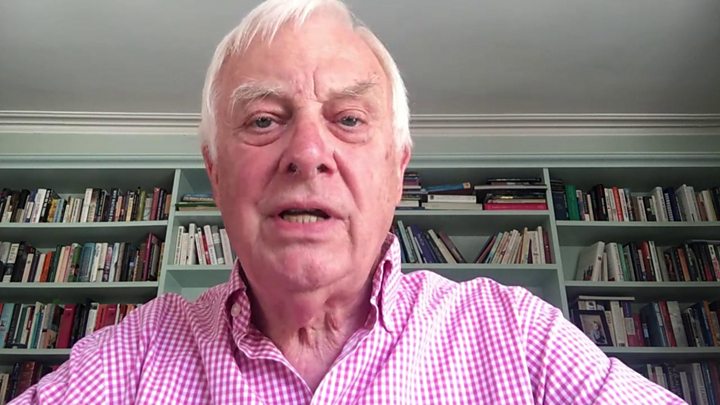
The statement was drafted by feeble Hong Kong Governor Christopher Patten and feeble British Foreign Secretary Malcolm Rifkind, and employed by 186 policy makers and politicians from 23 countries.
Media playback is unsupported on your device
It describes Beijing's plans as a "flagrant breach" of the Sino-British United Declaration, under which Hong Kong returned to Chinese rule in 1997.
"If the international public cannot trust Beijing to keep its word when it comes to Hong Kong, country will be reluctant to take its word on new matters," the signatories wrote.
They include 17 members of the US Assembly, and 44 UK MPs.
The NPC is predictable to vote on the draft law at the end of its annual session, on 28 May. It will then be forwarded to the NPC's Standup Committee, China's top legislature, which is predictable to finalise and enact the law by the end of June.
Media playback is unsupported on your device
Sincery Just Another Blog
SRC: https://www.bbc.com/news/world-asia-china-52786734
powered by Blogger News Poster
Comments
Post a Comment